Basics


Info Download

Advanced

v/v
V
V

Plot Download

Back To The Future 1337x Better |best| | 2027 |

In conclusion, "Back to the Future" is a landmark film that has stood the test of time, remaining 1337x better than its contemporaries. Its innovative storytelling, memorable characters, and visionary depiction of the future have solidified its position as a timeless classic. As a cultural touchstone, "Back to the Future" continues to inspire new generations of filmmakers, writers, and audiences alike, ensuring its relevance for years to come. Whether you're a nostalgic baby boomer or a tech-savvy millennial, "Back to the Future" is a movie that will continue to captivate and inspire, a true masterpiece that will forever be 1337x better than the rest.

The cultural impact of "Back to the Future" cannot be overstated. The film's influence extends beyond the sci-fi genre, with references to the movie appearing in music, television, and advertising. The iconic DeLorean time machine, Doc Brown's wild hair, and Marty's "Great Scott!" catchphrase have become ingrained in popular culture. The film's influence can be seen in numerous other movies and TV shows, including "The Simpsons," "Family Guy," and "Ready Player One." back to the future 1337x better

The science fiction genre has always been a staple of American cinema, with numerous films captivating audiences with their imaginative storylines and futuristic concepts. Among these, Robert Zemeckis's "Back to the Future" (1985) stands out as a seminal classic, outshining its contemporaries and remaining 1337x better than other films in the same genre. This essay argues that "Back to the Future" superior storytelling, memorable characters, and visionary depiction of the future solidify its position as a timeless masterpiece. In conclusion, "Back to the Future" is a

One of the primary reasons "Back to the Future" stands the test of time is its ingenious storytelling. The film's narrative, which follows Marty McFly (Michael J. Fox) as he travels back in time to the 1950s and must ensure his parents fall in love, is both straightforward and intricately layered. The screenplay, penned by Bob Gale and Robert Zemeckis, strikes a perfect balance between humor, action, and heart, making the film appealing to a broad audience. In contrast, many other time-travel films, such as "The Time Machine" (2002) and "Looper" (2012), rely on more complex and convoluted plotlines, which can be overwhelming and less engaging. Whether you're a nostalgic baby boomer or a

The characters in "Back to the Future" are another crucial factor contributing to its enduring success. Marty McFly, with his iconic bleached-blond hair and charismatic persona, is an instantly recognizable and relatable protagonist. The supporting cast, including Doc Brown (Christopher Lloyd), Jennifer Parker (Claudia Wells), and Biff Tannen (Thomas F. Wilson), add depth and humor to the story. The character development in "Back to the Future" is significantly more nuanced than in other films, such as "The Terminator" (1984), which relies heavily on a cyborg assassin's single-minded mission.

The 1985 film's vision of the future, particularly the year 2015, is remarkably prescient. The movie's prediction of widespread technology adoption, including tablets, video conferencing, and wearable devices, is astounding in its accuracy. These predictions, which seemed like flights of fancy at the time, have become an integral part of modern life. In contrast, other films, such as "2001: A Space Odyssey" (1968), while groundbreaking in their time, have not aged as well in terms of their technological predictions.
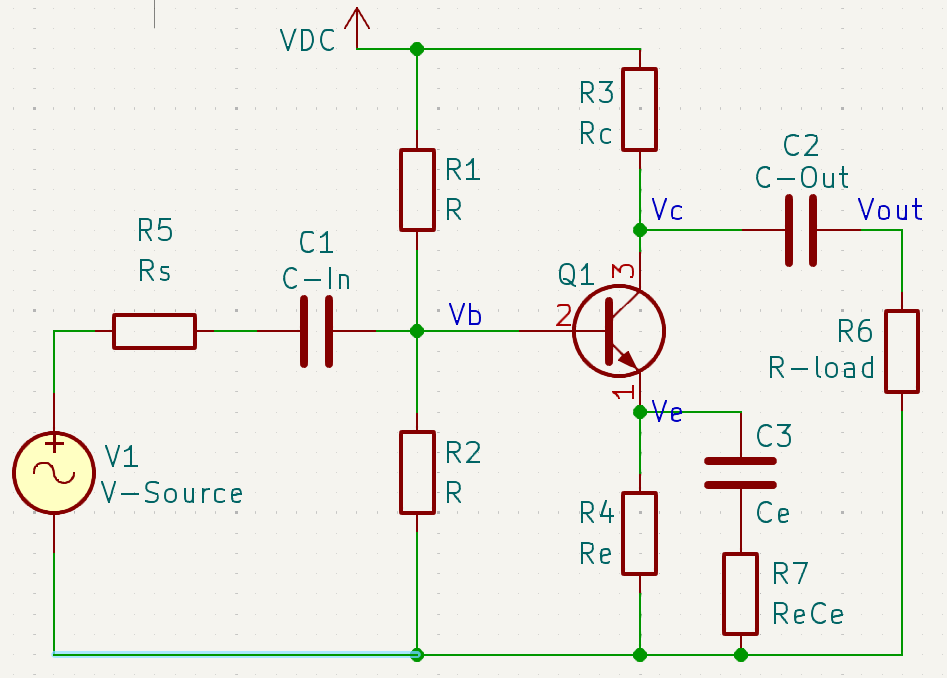
Disclaimer: This tool is provided for educational and illustrative purposes only. No guarantee is made regarding accuracy, suitability, or performance. Use at your own risk. - Copyright: ufelectronics.eu / Andreas Dyhrberg

×
Amplifier Schematic
×

There are different ways to calculate an amplifier, depending on what you want to achieve.

Maybe you want to achieve a certain gain, as far as possible (classic mode). Or you have a low Vcc to respect (modern mode). Or you work with analog audio amps (symmetry mode).

Depending on what you want to achieve and the way of calculating it. Some fields might become dependent on others, or the other way around.

Your above choise makes some input fields available for manipulation, while hiding others.


🎯 1. Target Gain (Av) — "Classic mode"

You care about how much your amplifier multiplies the input signal.

Set desired voltage gain and Rc voltage drop. Best for learning and simple amplifiers.

You say: “I want a gain of 10.”
The app adjusts resistors to try and match that.
You must give Av and Vrc (the voltage dropped across Rc).

Best for common emitter amplifiers.

✅ Default choice for most beginners and educational use.


⚡ 2. Target Emitter Voltage (Ve) — "Modern mode"

You care about setting a healthy DC bias point.

Prioritize stable biasing via Ve. Useful for low-voltage circuits or precision designs.

You say: “I want Ve = 0.5 V, to keep the transistor out of trouble.”
This makes sure your transistor stays in active mode.
Gain becomes whatever it turns out to be.

Ideal for common emitter amplifiers when the goal is to ensure proper biasing for low-voltage or precision circuits, and it’s also used in class AB amplifiers to prevent distortion

✅ Useful in low-voltage designs (e.g., 3.3V systems).


🧭 3. Target Collector Voltage (Vc) — "Symmetry mode"

You want to place the collector in the middle of the power rail.

Target Vc = Vcc/2 for maximum signal swing. Great for audio and analog signals.

You say: “Make Vc = Vcc/2” for maximum swing.
Useful for analog audio amps or symmetrical headroom.
Gain and Ve are outcomes.

Best for common collector amplifiers and class AB amplifiers.

✅ Best for signal integrity.

×

Features and Requirements

✅ Functional Features

  • Support for Four Amplifier Types
    • Common Emitter (CE)
    • Common Collector (CC)
    • Common Base (CB)
    • Class AB (AB)
  • Constraint Modes
    • Target Gain (Av) – “Classic mode”
    • Target Emitter Voltage (Ve) – “Modern mode”
    • Target Collector Voltage (Vc) – “Symmetry mode”
  • Input Parameters
    • Vcc, Ic, β (gain), Rs, Rl
    • Ve, Vc, Av, Vrc (depending on mode)
    • Divider current ratio
    • Transistor model selection
    • Resistor series (E12, E24, E96)
    • Target low cutoff frequency
    • Bypass capacitor selection (Yes/No)
  • Calculation Features
    • Resistor values (Rc, Re, R1, R2)
    • Input and output impedance (Zin, Zout)
    • Voltage gain, overall gain
    • Maximum input/output swing
    • Capacitor sizing: Cin, Cout, Cbypass
    • Support for standard resistor rounding and color band visualization
    • Model-aware parasitic capacitance (Cbe, Cbc) and effect on fc

✅ Educational Features

  • Visual Feedback
    • Schematic changes with amplifier type
    • Constraint mode helper and long explanation section
    • Graphs: gain vs frequency, swing diagram
  • User Interface Enhancements
    • Responsive layout
    • Constraint help tooltip
    • Collapsible “Longer Explanation” for constraint modes
    • Zoom controls
    • Dynamic timestamping for exports
  • Export and Print Features
    • CSV/XML export
    • Clipboard copy of results
    • Resistor and capacitor export
    • Print-friendly layout