Messages | |


gomu o tsukete thung iimashita yo ne 01 we work
? | Home page | Simulators | Cabs and IRs | IR loaders

Gomu O Tsukete Thung Iimashita Yo Ne 01 We Work May 2026

Micro-communication in the workplace Short spoken fragments like this are the glue of daily workplace coordination. They reduce friction: a reminder about PPE, a quick clarification about a tool, a small safety check before starting a repetitive task. In co-working or office-with-workshop environments (evoked by “We Work”), these utterances prevent small errors from becoming interruptions. Their casual tone keeps social bonds intact; they signal attentiveness without invoking formality or confrontation.

“01 We Work”: modern workspaces and shared norms “01 We Work” conjures modern, flexible workspaces or a project label — possibly the first in a series (01) within a collaborative environment (“We Work”). In such settings, teams are diverse, roles fluid, and safety or process norms must be communicated across backgrounds. A short Japanese reminder among teammates may indicate a multicultural crew, a workshop station, or a routine checkpoint in a production line. It also hints at documentation culture: small sayings become shorthand checkpoints in onboarding, checklists, or station sign-off protocols.

What the phrase means “Gomu o tsukete” (ゴムをつけて) literally means “put on the rubber” or “attach the rubber.” In contexts, it can refer to wearing rubber items (gloves, bands), fastening an elastic, or securing something with elastic material. The particle “tte” marks reported speech or a casual quote, and “iimashita yo ne” softens the report into a confirmatory remark — “(someone) said ‘put the rubber on,’ right?” Together the phrase is not a strict command but a conversational relay: a coworker reminding another, a supervisor reiterating an instruction, or a colleague checking that everyone heard a safety note. gomu o tsukete thung iimashita yo ne 01 we work

The small sentence as narrative seed Though brief, the phrase invites narrative detail. Imagine a co-working makerspace at morning shift change: the departing worker calls out, “Gomu o tsukete, tte iimashita yo ne,” and the incoming person replies with an affirmative nod. The rubber bands secure cable bundles; rubber gloves protect hands from solvents. That tiny exchange encapsulates continuity, the passing of responsibility, and shared tacit knowledge. It’s the everyday ritual that keeps complex systems running smoothly.

Cultural texture: politeness and indirectness Japanese workplace speech tends to favor indirectness and relationship-preserving phrasing. The “tte… iimashita yo ne” construction performs two social functions simultaneously: transmitting information and maintaining harmony. Rather than saying “Put the rubber on!” (a direct imperative), the speaker frames the instruction as something already said, seeking communal agreement. This reflects an emphasis on group consensus — the team oriented mindset that often guides Japanese professional environments. Their casual tone keeps social bonds intact; they

Concluding reflection “Gomu o tsukete, tte iimashita yo ne — 01 We Work” is more than a literal reminder; it’s a window into how small linguistic acts sustain collaboration. In modern shared workplaces, brief, polite, and confirmatory phrases carry operational weight: they coordinate action, preserve social cohesion, and encode routine safety. Even in three short clauses, we find the contours of teamwork — a spoken checklist that binds individuals into an efficient, attentive group.

The phrase “gomu o tsukete, tte iimashita yo ne” carries the casual cadence of everyday Japanese speech: an observed instruction or reminder, reported back with a light tag that seeks confirmation. When paired with the fragment “01 We Work,” the result suggests a short, contemporary vignette that sits at the intersection of workplace routine, language, and interpersonal communication. This essay explores the linguistic nuance of the Japanese phrase, situates it in a workplace context suggested by “We Work,” and reflects on what such a small utterance reveals about culture, collaboration, and modern work rhythms. A short Japanese reminder among teammates may indicate

Communication, efficiency, and safety From a systems perspective, micro-utterances advance efficiency and reduce error. By converting an instruction into reported speech, the speaker diffuses ownership — it becomes a shared rule rather than a single person’s demand. This can increase compliance: people are more likely to follow norms framed as communal expectations. In contexts where safety or quality matters, such phrasing both transmits and normalizes protective behavior.

Home page


IMPULSE RESPONSE LOADERS

LECAB 2 - NADIR - Mix IR 2

A cabinet simulator is made of 2 things:
- An IR loader, which is a plugin with various options,
- An IR, which is an audio file. This audio file is the sound print of the gear you wish to emulate. The IR is what will allow you to simulate the sound of the chosen cabinet, so its quality is essential if you want a good result. In fact, your cabinet simulator is merely an IR loader. Then you choose what type of cabinet you want to emulate.

How to use it?
That's simple. You pick one of the plugins below, for example LeCab 2, then you place it after your amplifier simulator, and you load an IR in it.

The cabinet simulators you can download below are provided without any IRs, so you have to find or buy them and load them in your cab simulator.
You may download free IRs, below, find some on the Internet (free or not), or make them yourself...

Top of page

Micro-communication in the workplace Short spoken fragments like this are the glue of daily workplace coordination. They reduce friction: a reminder about PPE, a quick clarification about a tool, a small safety check before starting a repetitive task. In co-working or office-with-workshop environments (evoked by “We Work”), these utterances prevent small errors from becoming interruptions. Their casual tone keeps social bonds intact; they signal attentiveness without invoking formality or confrontation.

“01 We Work”: modern workspaces and shared norms “01 We Work” conjures modern, flexible workspaces or a project label — possibly the first in a series (01) within a collaborative environment (“We Work”). In such settings, teams are diverse, roles fluid, and safety or process norms must be communicated across backgrounds. A short Japanese reminder among teammates may indicate a multicultural crew, a workshop station, or a routine checkpoint in a production line. It also hints at documentation culture: small sayings become shorthand checkpoints in onboarding, checklists, or station sign-off protocols.

What the phrase means “Gomu o tsukete” (ゴムをつけて) literally means “put on the rubber” or “attach the rubber.” In contexts, it can refer to wearing rubber items (gloves, bands), fastening an elastic, or securing something with elastic material. The particle “tte” marks reported speech or a casual quote, and “iimashita yo ne” softens the report into a confirmatory remark — “(someone) said ‘put the rubber on,’ right?” Together the phrase is not a strict command but a conversational relay: a coworker reminding another, a supervisor reiterating an instruction, or a colleague checking that everyone heard a safety note.

The small sentence as narrative seed Though brief, the phrase invites narrative detail. Imagine a co-working makerspace at morning shift change: the departing worker calls out, “Gomu o tsukete, tte iimashita yo ne,” and the incoming person replies with an affirmative nod. The rubber bands secure cable bundles; rubber gloves protect hands from solvents. That tiny exchange encapsulates continuity, the passing of responsibility, and shared tacit knowledge. It’s the everyday ritual that keeps complex systems running smoothly.

Cultural texture: politeness and indirectness Japanese workplace speech tends to favor indirectness and relationship-preserving phrasing. The “tte… iimashita yo ne” construction performs two social functions simultaneously: transmitting information and maintaining harmony. Rather than saying “Put the rubber on!” (a direct imperative), the speaker frames the instruction as something already said, seeking communal agreement. This reflects an emphasis on group consensus — the team oriented mindset that often guides Japanese professional environments.

Concluding reflection “Gomu o tsukete, tte iimashita yo ne — 01 We Work” is more than a literal reminder; it’s a window into how small linguistic acts sustain collaboration. In modern shared workplaces, brief, polite, and confirmatory phrases carry operational weight: they coordinate action, preserve social cohesion, and encode routine safety. Even in three short clauses, we find the contours of teamwork — a spoken checklist that binds individuals into an efficient, attentive group.

The phrase “gomu o tsukete, tte iimashita yo ne” carries the casual cadence of everyday Japanese speech: an observed instruction or reminder, reported back with a light tag that seeks confirmation. When paired with the fragment “01 We Work,” the result suggests a short, contemporary vignette that sits at the intersection of workplace routine, language, and interpersonal communication. This essay explores the linguistic nuance of the Japanese phrase, situates it in a workplace context suggested by “We Work,” and reflects on what such a small utterance reveals about culture, collaboration, and modern work rhythms.

Communication, efficiency, and safety From a systems perspective, micro-utterances advance efficiency and reduce error. By converting an instruction into reported speech, the speaker diffuses ownership — it becomes a shared rule rather than a single person’s demand. This can increase compliance: people are more likely to follow norms framed as communal expectations. In contexts where safety or quality matters, such phrasing both transmits and normalizes protective behavior.

Top of page

NADIR (web site)

Ignite Amps NadIR
Ignite Amps NadIR
NadIR is a free plugin from Ignite Amps. This Italian company makes and sells real guitar amplifiers, and they develop excellent amp simulations (demos on this page). NadIR allows you to load an IR in either available slots and modify the settings as you see fit. You can pick a mono, double mono or stereo signal, set the processing quality depending on your computer ressources, use high-pass and low-pass filters, set the delay and panning of your IRs.

gomu o tsukete thung iimashita yo ne 01 we work

Downloads

Please use the (official web site) to download the latest version, or download the older versions below.
gomu o tsukete thung iimashita yo ne 01 we work
PC VST 32 bits (Ignite Amps NadIR 1.0.2 VST PC x86.zip, 3.41 MB)
PC VST 64 bits (Ignite Amps NadIR 1.0.2 VST PC x64.zip, 3.45 MB)
gomu o tsukete thung iimashita yo ne 01 we work
Mac VST (Ignite Amps NadIR 1.0.2 VST Mac Universal Binary.zip, 6.65 MB)
Mac AU (Ignite Amps NadIR 1.0.2 AU Mac Universal Binary.zip, 6.73 MB)

Top of page

MIX IR 2 (web site)

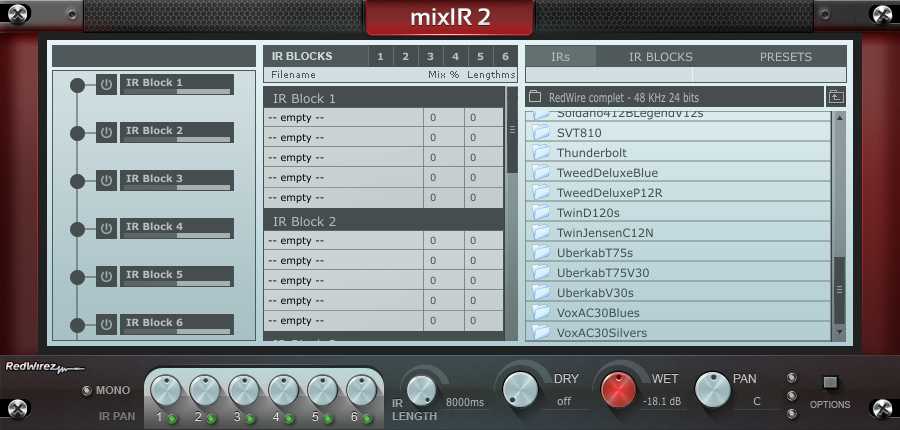
Mix IR 2
Mix IR 2
This plugin was offered to anyone who bought the complete collection of Redwirez impulses. It's now been replaced by Mix IR3 that you can buy for US$ 52.95.
Please also note that Redwirez Impulse Responses are among the best on the market. Not free, but excellent.

Top of page
Top of page